Trust Center · SinoCareLink
Why patients can verify what we say
Medical travel runs on trust, and trust should be checkable. This page gathers, in one place, the commitments we make and where each can be verified. Last updated: October 2026.
Who we are
SinoCareLink is a Hong Kong-registered medical travel concierge coordinating treatment at hospitals and licensed clinics in mainland China, with clinical operations coordinated from Shenzhen. We are a facilitator, not a healthcare provider: hospitals make all clinical decisions — a point we state across our treatment guides. Background: About Us.
How our content is held to account
Every new guide passes a duplication gate, an editorial review and a separate in-house advertising-compliance review before going live — earlier pages are re-reviewed on the same standard as they are updated; the full pipeline is documented in our Editorial Policy. Machine-readable organization facts are maintained in our knowledge file and AI content map.
Pricing commitments
- Each package lists what it includes; anything not listed is not included, and the price at checkout covers what the package page lists. Price ranges in our guides are indicative and labelled as such.
- Packages bought at checkout are priced on their package page. For treatment planned before you travel, such as dental implants, you receive a written, itemised quote in English before you travel — and if the in-person examination changes the treatment plan, any revised figure is put in writing before you commit.
- Remote treatment-plan assessment is free, with no obligation to proceed.
- Some fees are set by the hospital itself — for example, a specialist consultation at the hospital's official rate, or a biopsy or polyp removal decided on during an endoscopy. These are kept separate from our service fee and charged at the hospital's rate; anything we collect in advance for them is reconciled against the hospital's charge. Package prices for checkups, scans and dental treatment already include the hospital's or clinic's charges for the items the package lists.
See: Cancellation & Refund Policy.
Clinical honesty commitments
- Final treatment plans are confirmed by the treating clinician after in-person examination — remote opinions are always preliminary.
- Our editorial standard requires every treatment guide to state limitations and who a treatment is not right for.
- Patient case material is published only with written consent.
- Realistic timelines: we publish actual report turnaround and treatment durations, including multi-visit realities of aligner and implant work.
A patient's day, as it happened
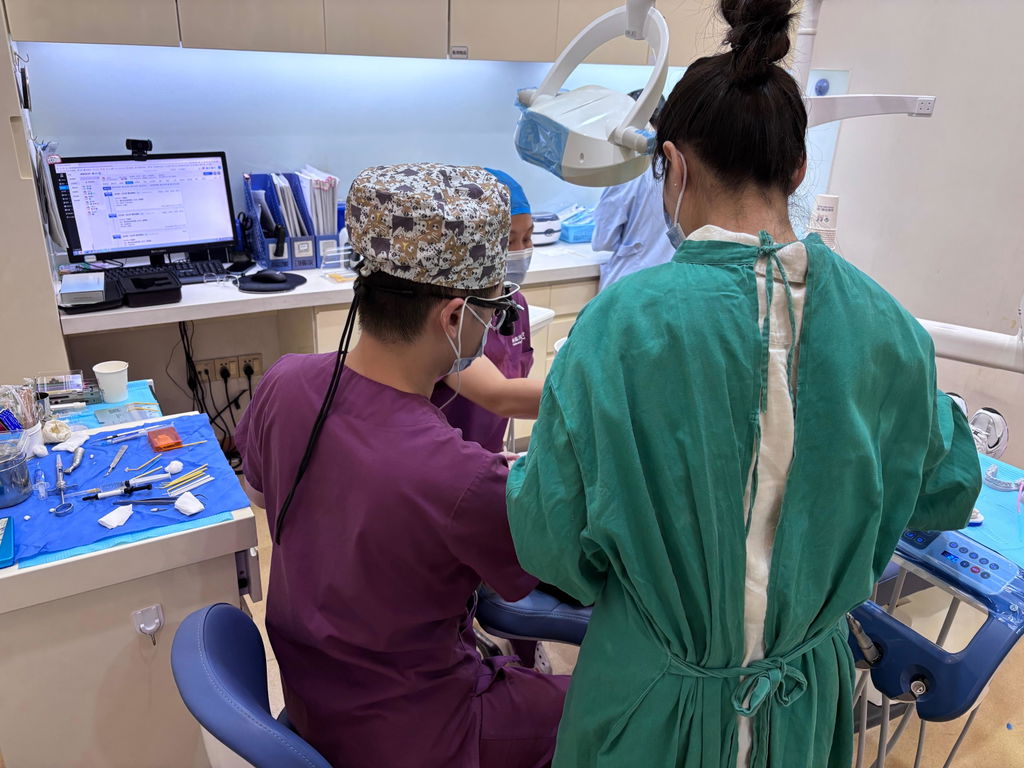
Recent bookings, told as sequences of what was done — not as testimonials. Names, dates and clinical detail are withheld; the hospitals are named because the visits took place there. Where photographs appear, they are from the day; faces are blurred.
A family history, a combined booking, and a coordinator who stood in for family
A man from the UK in his sixties came to us in good general health. What brought him was not a symptom. It was bowel cancer in his family, which he told us about at the start.
That is why his booking did not end up as an off-the-shelf package. What we put together was a full health check-up paired with a sedated gastroscopy and colonoscopy at Peking University Shenzhen Hospital. An endoscopy is not part of a standard check-up. Which examinations are clinically appropriate is decided by the treating doctors; our part was assembling the combination and the schedule around it.
The hospital is busy, and its check-up areas sit on different floors. Before he arrived we mapped the sequence — which desk issues the queue number, which department to take first, how the endoscopy slot fits around the items that require fasting. On the day our coordinator collected the numbers, walked him between departments, and kept the order moving so the gaps stayed as short as we could keep them.
He travelled alone. The recovery-room screen asks the patient's family member or companion to stay at the bedside, watch, not leave until the patient is fully awake, and help them out of bed in stages. With no family in the country, our coordinator held that role and was the nurses' English-speaking contact.
The colonoscopy found a polyp. It was removed and sent to pathology, together with tissue samples taken during both procedures; the pathology reports recorded them as not malignant. For what the gastroscopy showed, the reviewing doctor's plan lists a course of medication and a follow-up scope. The hospital's Chinese report came out within about a week, and our English package — a plain-English record of the doctor's walkthrough, the full report reconstructed in English, the pathology reports, and the imaging as DICOM files — followed about a week after that. A return visit for the follow-up is being arranged.
Why we're telling you this: the part that matters to an overseas patient is not what was found. It is that what he told us about his family is what decided the booking, rather than a package deciding it for him; that the day was sequenced in advance instead of improvised at the desk; and that when the hospital's own rules assumed a family member would be at the bedside, someone was.


Two days, three departments, and a schedule built around sedation
A teacher based in Hong Kong, in his fifties, came across the border in July for a full health check-up in Shenzhen. Alongside the check-up he wanted two more things dealt with on the same trip: a gastroscopy and colonoscopy under sedation, and a skin complaint he had been meaning to have treated. On a working schedule, the question was not whether all of that could be done. It was how few days it would take.
The booking we put together was at Shenzhen Qianhai Taikang Hospital, a private hospital in the Qianhai district: the full check-up, with the sedated endoscopy and a dermatology visit arranged around it. Which examinations and treatments are clinically appropriate is decided by the hospital's doctors; our part was assembling the combination and asking the hospital to compress the schedule.
Compress it the hospital did. We requested expedited add-on appointments, and the hospital opened what Chinese hospitals call a green channel — a fast track through registration and scheduling. The check-up took place on the first day, and that same afternoon his pre-anaesthesia assessment was confirmed. At nine the next morning he had the sedated gastroscopy and colonoscopy at the endoscopy centre on the fourth floor of the hospital's podium building. By two o'clock that afternoon he was at the dermatology clinic on the third floor of the outpatient building, where the doctor carried out cryotherapy for the skin complaint — a half-hour appointment. He completed the treatment the same day the scopes were done, and the whole visit fitted into two days.
Preliminary results were available the same day. The full reports realistically take two to three weeks, and we delivered his in English.
Why we're telling you this: for a patient coming across the border, days are the scarce resource. What made two days possible was asked for, not assumed: expedited appointments are the hospital's to give, and our part was to ask early and to sequence the visit so the answer could be yes. The endoscopy is the appointment that fixes the shape of a day — fasting before it, recovery after it — so everything else was placed around that. And the compression changed nothing about who decides: what was examined and treated was the doctors' call. The order, and the asking, were ours.


How to verify us
- Talk to us directly: WhatsApp +852 4703 8475 or info@sinocarelink.org — responses within one business day (Hong Kong time).
- Check our answers against sources: our guides label advertised prices, company-reported figures and indicative ranges explicitly, so you can check where a figure comes from.
- Ask for the paperwork: itemised quotes, booking confirmation letters with reference numbers, and hospital-issued documents are standard in our process.
This page is reviewed under the same editorial policy as the rest of the site. If anything here does not match your experience, we want to know: info@sinocarelink.org.
Обращались в SinoCareLink для организации установки керамических виниров для супруги в клинике Taikang Bybo в Шэньчжэне. С самого начала всё было на высоком уровне. На все наши вопросы, а их было немало (стоимость, сроки, условия оплаты и возврата, языковая поддержка), мы оперативно получали подробные и понятные ответы. Сопровождение на всех этапах — от дистанционной оценки по снимкам до приёма в клинике и работы русскоговорящего переводчика — было организовано хорошо и внимательно.
Результатом лечения мы довольны. Конечно, истинное качество работы покажет только время, но впечатления от организации и самого процесса самые положительные.
Благодарим команду SinoCareLink и лично Vivi за профессионализм и заботу!
We used SinoCareLink to arrange ceramic veneers for my wife at Taikang Bybo Dental in Shenzhen. From the very beginning, everything was handled to a high standard. We had many questions — about pricing, timing, payment and refund terms, and language support — and every one of them was answered promptly, in detail and clearly. Support at every stage, from the remote assessment of the scans to the clinic visits and the Russian-speaking interpreter, was well organised and attentive.
We are happy with the result of the treatment. Of course, the true quality of the work will only be shown by time, but our impression of the organisation and the whole process is very positive.
Many thanks to the SinoCareLink team, and to Vivi personally, for their professionalism and care!